


 Contact us








Is Your Costa Blanca Property Really Worth That?
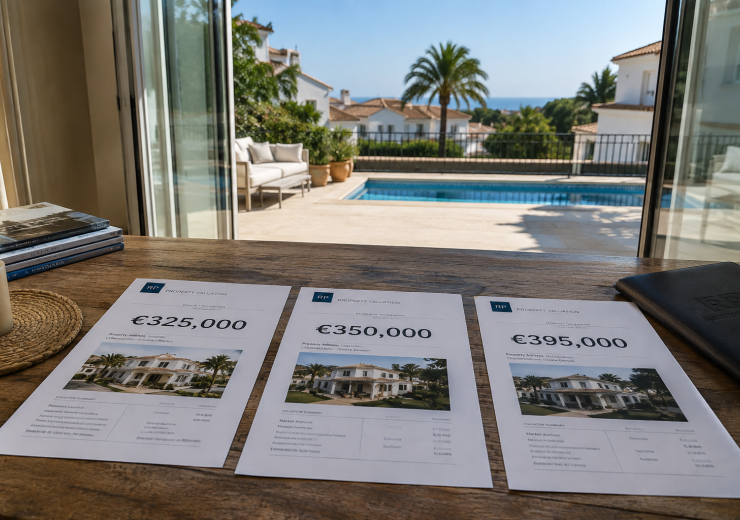
A homeowner invites three estate agents to value a property. The first suggests €325,000. The second believes the market could support €350,000. The third says €395,000. Assuming all three appear equally professional and confident in their assessment, it is not difficult to understand which figure is likely to command the homeowner’s attention.
There may, of course, be a perfectly credible case for €395,000. Perhaps the property occupies an exceptional plot, comparable stock is scarce, recent transactions demonstrate stronger demand or its condition and specification place it well above competing homes. A higher valuation is not inherently an incorrect valuation, just as a lower valuation is not necessarily evidence of greater professionalism. The important question is considerably simpler: what evidence supports the figure?
That question matters in the current Spanish property market because prices have genuinely risen, and substantially. According to the Instituto Nacional de Estadística (INE), residential property prices across Spain increased by 12.9% year on year in the first quarter of 2026. Resale property, particularly relevant to the established Costa Blanca market, recorded an even stronger annual increase of 13.5%. In the Comunitat Valenciana, the annual increase was 14.3%. These are not asking price statistics from property portals. The INE index measures the evolution of prices actually paid for residential property purchased by households, using administrative transaction data covering approximately 95% of housing sales during the quarter.
There is therefore little argument that homeowners have benefited from a strong period of appreciation. The question is not whether Costa Blanca property values have risen. They have. The more interesting question is what happens when yesterday’s strong sale becomes today’s expectation, and today’s expectation is then used to justify tomorrow’s asking price.
In a rising market, that distinction can become blurred remarkably quickly. A neighbour achieves an excellent result. Another property appears online at a higher figure. A third owner sees both and understandably concludes that their home should be worth at least as much. Before long, asking prices themselves begin influencing expectations, despite the fact that some of the properties being used as evidence may never have sold at those figures.
This is where valuation, pricing strategy and salesmanship need to be separated. An asking price represents what an owner would like to receive. A market valuation is a reasoned assessment of what the evidence suggests a property could achieve. The eventual sale price is the point at which a willing buyer and willing seller actually agree to transact. Those three numbers may be close, but they are not necessarily the same thing.
Who actually decides what a property is worth?
Property valuation is sometimes presented as though an estate agent walks into a home, looks around and somehow knows what it is worth. In reality, a credible valuation is a process of comparison, adjustment and professional judgement.
Spain’s formal property valuation framework provides a useful illustration of how that process should work. The official methodology recognises several valuation approaches, including the comparison method. Where comparison is used, the regulations require a representative market, sufficient information about comparable transactions or offers and, for formal valuations under the relevant provisions, information on at least six comparable properties. The methodology also requires differences between those properties to be analysed and adjusted rather than treating every superficially similar home as equivalent.
An estate agency market appraisal is not the same thing as a formal mortgage valuation carried out under the ECO regulations, but the underlying principle is instructive. Value should be supported by evidence, not created by assertion.
That means identifying genuinely comparable properties and understanding why one achieved more or less than another. Location matters, even within the same urbanisation. Plot size, orientation, views, privacy, road position, build quality, condition, outside space, pool, parking, accessibility and legal status can all influence what a buyer is prepared to pay. Two villas with the same number of bedrooms and approximately the same constructed area can therefore have materially different market values.
Recency matters too. A transaction completed several years ago may provide historical context, but it says considerably less about today’s market than a comparable transaction completed recently. Equally, a property currently advertised for €500,000 provides useful information about the competition facing a seller, but it does not prove that €500,000 is achievable. Until somebody actually buys it, that figure remains evidence of seller expectation rather than completed market value.
The distinction is reflected even within formal Spanish valuation methodology. The comparison method calls for analysis of real transactions and appropriately adjusted firm offers, the selection of representative comparables and the identification of abnormal data. For certain valuation purposes, the regulations explicitly require procedures capable of identifying and eliminating speculative elements.
This is also why price per square metre needs to be used intelligently. It is a valuable market indicator, particularly across large datasets, but buyers do not purchase an abstract square metre. They purchase a particular home, on a particular plot, in a particular street, with a particular combination of characteristics. A panoramic view, superior privacy or exceptional outside space cannot always be captured adequately by multiplying the constructed area by an average figure.
The latest Registradores data illustrate why broader market statistics still matter. Their first quarter 2026 figures recorded an 8.9% annual increase in the average registered residential price per square metre nationally. They also recorded 178,096 residential transactions during the quarter, with 701,828 over the preceding twelve months. In other words, there is a substantial body of completed transactional evidence against which market expectations can be tested.
For the Costa Blanca, another statistic is particularly significant. Foreign purchasers accounted for 44.65% of residential purchases in Alicante province during the first quarter of 2026, according to the Colegio de Registradores. Alicante therefore continues to operate within a highly international property market, where purchasing power and buyer motivations can differ considerably from those in areas dependent predominantly on domestic demand.
That international demand can support premiums, particularly for properties offering the characteristics foreign buyers actively seek. It can also make valuation more complex. A Scandinavian buyer looking for a winter residence, a Belgian couple relocating permanently, a British family purchasing a holiday home and a Spanish buyer looking for a primary residence may all assess the same property differently. This does not make valuation arbitrary. It means the agent needs to understand who the likely buyer is and what comparable buyers are actually paying.
A strong valuation should therefore be capable of answering a series of practical questions. What has genuinely sold nearby? What is currently competing for the same buyer? How does the property compare in condition, position and specification? What has changed in the market since the comparable transactions took place? Is there sufficient demand within this particular price bracket? Most importantly, what evidence suggests that a buyer exists at the proposed figure?
If an agent is recommending a price substantially above the available comparable evidence, there may be a valid reason. The seller should simply expect that reason to be explained.
The highest valuation in the room
This is where property valuation meets the commercial reality of estate agency.
An agent invited to value a home is often performing two functions simultaneously. They are being asked to provide professional advice on its likely market value while also competing with other businesses for the instruction to sell it. There is an obvious tension between those objectives when the homeowner understandably prefers the agent offering the most attractive financial outcome.
Return to the property valued at €325,000, €350,000 and €395,000. If the owner chooses the €395,000 agent, it does not make them greedy or unrealistic. Faced with the possibility of receiving another €45,000 or €70,000 for one of their largest financial assets, most people would want to believe the higher figure.
That places responsibility on the professional giving the advice.
The €395,000 valuation might prove entirely correct. Perhaps the other agents have been too conservative or failed to recognise how quickly demand has moved. In a market where the INE is currently recording double digit annual price growth, relying too heavily on older comparables can itself result in undervaluation. Correct valuation should not mean conservative valuation. A seller is entitled to expect an agent to pursue the strongest price that current evidence and demand can reasonably support.
The difficulty arises when a high valuation is being used primarily to secure the instruction, with the expectation that the asking price can be reduced later if buyers fail to respond.
That strategy can appear relatively harmless. Put the property on at the higher figure, see what happens and adjust if necessary. However, it overlooks something important about how property is marketed.
A new listing enters the market with freshness. Active buyers notice it, property alerts are triggered, agents have a reason to contact clients already searching within that area and there is a period when the property has not yet become familiar. If that initial exposure is spent at a price substantially beyond what its target buyers consider credible, reducing it months later does not entirely recreate the original opportunity.
The property is no longer new to the market. Some buyers will already have dismissed it. Others may have purchased elsewhere. A series of reductions can also change the psychology surrounding the listing, encouraging buyers to ask whether another reduction may follow or whether there is a reason the property has remained unsold.
This does not mean every property needs to be priced aggressively for a quick sale. Far from it. The correct strategy depends on the seller’s objectives, the strength of the evidence and the amount of time available. It does mean that the original asking price should be a strategic decision, not simply the number most likely to win the instruction.
When asking prices start valuing other asking prices
One of the more subtle risks in a strongly appreciating market is the way advertised prices can begin reinforcing one another.
Consider three broadly comparable villas. Villa A enters the market at €450,000. The owner of Villa B sees it and believes their home has a better plot and more modern interior, so €475,000 appears reasonable. Villa C then comes to market several months later. Its owner can now see comparable properties advertised at €450,000 and €475,000 and concludes that €495,000 is justified.
On paper, the neighbourhood appears to have gained almost €50,000 in value.
There is only one problem: none of the three properties has sold.
The figures may ultimately prove correct. A buyer could arrive tomorrow and purchase Villa C for close to its asking price. Until transactions occur, however, what has increased with certainty is price expectation, not necessarily market value.
This is why advertised properties are useful but imperfect comparables. They tell an agent what buyers can currently choose from and where sellers are positioning themselves. Completed transactions provide something different: evidence that a buyer was actually prepared to exchange money at that level.
A healthy rising market needs room for sellers and agents to test new price levels. Without somebody achieving a higher figure, values could never move upwards. The distinction is between testing the upper end of a defensible market range and allowing one optimistic asking price to become the justification for the next.
Current data make that distinction particularly important. With Spanish residential prices rising 12.9% annually and the Comunitat Valenciana recording 14.3% growth in the first quarter of 2026, there is genuine appreciation to account for. That strength should give sellers confidence. It should not remove the need for evidence.
A rising market can justify a higher valuation. It cannot make every valuation correct.
Why hasn't your property sold?
A property remaining unsold does not automatically mean it is overpriced. Marketing may be inadequate, presentation may fail to show the home at its best, access for viewings can be difficult and some properties naturally appeal to a narrower audience. There are also price brackets where the number of potential purchasers reduces considerably. A villa at €450,000 and one at €950,000 are not competing for buyer pools of the same size, so the time required to secure a sale cannot be judged in exactly the same way.
Patience is therefore part of the pricing equation. A seller with no particular deadline may reasonably decide to hold out for a stronger price, provided the valuation remains supported by the market and they understand that finding the right buyer may take longer. This can be particularly relevant for distinctive properties where there are fewer direct comparables and fewer potential purchasers, but where the right buyer may place considerable value on characteristics that are difficult to replicate.
The calculation changes when speed becomes the priority. A seller who needs or wants a quick sale generally has to make the property particularly competitive against everything else available to the same buyer. In practical terms, that may mean accepting less than could potentially be achieved by waiting longer. This is not necessarily selling cheaply. The seller is placing a financial value on speed, certainty and a shorter marketing period.
This is why promises about how quickly a property can be sold should always be considered alongside the proposed price. A seller looking to maximise every possible euro and a seller who wants a completed transaction as quickly as possible are pursuing different objectives. It is difficult to promise both the absolute maximum price and the shortest possible marketing period without recognising that there can be a trade-off between the two.
Time on the market nevertheless becomes valuable evidence. If a property has been widely advertised, is appearing in relevant searches and has been exposed to the appropriate buyer audience for a prolonged period without generating meaningful enquiries, the market is communicating something. The same applies when a property receives regular viewings but prospective buyers consistently purchase alternatives. In both situations, the professional response should be to understand why rather than automatically blaming the marketing or immediately prescribing a price reduction.
Buyer feedback can be particularly useful when patterns emerge. One purchaser disliking a kitchen is personal preference. Several buyers commenting on road noise may identify a characteristic that affects marketability. Repeated feedback that comparable properties offer more for the same budget begins to say something about value. Good estate agency involves distinguishing between isolated opinions and consistent market signals.
Sometimes the conclusion will be that the asking price remains justified and patience is the correct strategy. Perhaps the property has an unusual feature for which the right buyer has not yet appeared, or there is little comparable stock against which it can be judged. At other times, the evidence will demonstrate that the market is not supporting the original valuation.
The important distinction is between deliberately waiting for the right buyer at a defensible price and simply waiting because the original asking price has proved unrealistic.
People will pay what they think a property is worth
There is considerable truth in the idea that a property is ultimately worth what somebody is prepared to pay for it. Residential property is not a uniform financial product, and personal value can have a significant influence on individual transactions.
A buyer may have spent two years waiting for a villa in a particular street. They may want to live close to family or friends. A specific sea view, unusually large plot, south-facing garden or frontline golf position may be difficult to reproduce elsewhere. A home may simply provide a combination of location, condition and lifestyle that the buyer has been unable to find within the existing market.
In those circumstances, a buyer may reasonably pay a premium. That does not automatically mean they have overpaid. If the property offers something particularly valuable to them and they have considered the alternatives available, their assessment of value may legitimately differ from that of another purchaser.
The difficulty arises when an individual transaction is subsequently treated as proof that every superficially similar property has the same value. An exceptional buyer can create an exceptional sale without necessarily resetting an entire market.
This is particularly relevant in Alicante province because of the scale of international demand. Foreign purchasers represented 44.65% of residential transactions in the province during the first quarter of 2026, the highest proportion recorded among Spain's provinces in the Colegio de Registradores data. Buyers arriving from different countries bring different budgets, housing-market experiences and motivations, which can support prices for properties that meet particularly sought-after criteria.
International demand does not, however, make price irrelevant. A Dutch, Belgian, British or Scandinavian buyer considering the Costa Blanca can compare a substantial number of properties before travelling to Spain. They can also compare different municipalities, inland and coastal locations, new build and resale stock and, increasingly, alternative regions. A strong international market therefore creates demand, but it also creates an informed buyer who can assess what a particular budget buys elsewhere.
The phrase "someone will pay it" may occasionally prove correct. As a pricing strategy, however, it requires more substance. The relevant questions are how many potential buyers exist at that level, what alternatives they have and what makes this particular property sufficiently compelling for one of them to pay the proposed price.
Inflation, appreciation and the changing value of money
Any discussion about overpricing needs to recognise that today's property values cannot reasonably be compared with those of five or ten years ago without considering the wider economic environment. General inflation has changed the purchasing power of money, while construction, labour and renovation costs have increased. Land in established areas is finite, new housing supply takes time to deliver and strong demand has placed additional pressure on existing stock.
The Banco de España has repeatedly identified the imbalance between strong housing demand and relatively limited new supply as an important factor behind Spain's housing market pressures. Its analysis has also highlighted the implications for affordability, particularly where house prices and rents rise faster than household incomes.
For homeowners who purchased before the recent period of appreciation, substantial increases in value can therefore be entirely legitimate. A property bought for €200,000 does not remain a €200,000 property simply because that was its purchase price. Equally, the fact that its value has risen does not establish that every additional increase in the owner's expectations is supported by the market.
This is where inflation and property appreciation need to be distinguished. Inflation describes the broader change in price levels and purchasing power. Residential property appreciation reflects what is happening within the housing market itself. The two interact, but they are not interchangeable. A homeowner cannot simply apply cumulative general inflation, add the cost of every improvement made to the property and assume that the resulting figure represents market value.
Renovation provides a good example. Spending €40,000 on a new kitchen, bathrooms and outside space may significantly improve a property's condition and saleability. It may also increase its market value. It does not automatically follow that a buyer will pay exactly €40,000 more for it. Buyers compare the finished property with other finished properties available within the same budget, rather than reimbursing the seller for each euro previously spent.
The same principle applies to ownership costs. Taxes, mortgage interest, maintenance and the cost of selling are real expenses for the owner, but they do not independently determine what the next purchaser will pay. The market does not know how much a seller needs to receive in order to achieve a particular return. It evaluates the property against the alternatives.
That leads to one of the most useful questions in residential valuation: what else can a buyer purchase for the same money?
A buyer with €500,000 does not assess a €500,000 villa solely against what that villa sold for five years earlier. They compare it with the other homes available around €500,000 today. If those alternatives offer better locations, larger plots, superior condition or stronger views, the subject property has to compete with them. If the property is clearly superior, the evidence may support a higher price.
This competitive relationship is ultimately what keeps a market functioning even during periods of strong appreciation.
When price growth begins to affect the market itself
Rising property values are generally positive for existing homeowners. They create equity, support confidence and can encourage investment in property improvement. A strong market also reflects something fundamentally positive about an area: people want to own property there.
The Costa Blanca has benefited substantially from this demand. Alicante's exceptionally high proportion of foreign purchasers demonstrates the depth of its international appeal, while the latest national and regional price indices confirm that residential values have continued to increase strongly.
There is, however, a point at which sustained price growth begins to have wider consequences. Housing markets depend not only on existing owners but on the next generation of purchasers capable of entering them. When property prices rise materially faster than incomes over a prolonged period, affordability deteriorates. Deposits become harder to accumulate, borrowing requirements increase and the range of homes available to buyers within a particular budget contracts.
For local residents, the consequences can be particularly visible in areas with substantial international purchasing power. Younger buyers may find ownership increasingly difficult in the communities where they grew up, while employees working in popular coastal areas may need to look progressively further away for affordable housing. These are not arguments against international investment or rising property values. They are consequences of a market in which demand, income and supply are moving at different speeds.
International buyers are not immune to the calculation either. If a purchaser concludes that a particular Costa Blanca location no longer represents reasonable value, increasing the budget is only one option. Another is to move a few kilometres away, consider a neighbouring municipality or compare the property with another part of Spain.
Price therefore has the capacity to change demand as well as respond to it.
A strong market can sustain significant appreciation when buyers continue to see sufficient value to transact. An overheated market is different. Expectations begin moving ahead of what an adequate number of buyers can support, transaction decisions become more difficult and affordability starts influencing behaviour.
The distinction matters because a healthy property market needs confidence on both sides of the transaction. Sellers need confidence that their asset is being valued properly. Buyers need confidence that the price they are paying bears a credible relationship to the property and the wider market.
Maintaining that confidence becomes particularly important when new businesses, different agency models and increasingly aggressive pricing strategies enter an already competitive market.
Disrupting a market is not the same as inflating it
Competition within estate agency is healthy. New businesses enter established markets, technology changes the way properties are presented and sold, and different commercial models challenge agencies to improve their service. Sellers benefit when competition produces better marketing, stronger communication, broader international exposure and more efficient transactions.
A market disruptor can therefore be a positive force. The concern is not disruption itself, nor is it an established agency objecting to somebody new entering the market. The more relevant question is how that business intends to compete.
One of the quickest ways for an agency to build a portfolio of listings is to provide homeowners with valuations above those being suggested by competitors. From the seller's perspective, the proposition is understandably attractive. If one agent believes a property should be marketed at €425,000 while another suggests €475,000, there is an immediate financial incentive to test the higher figure.
There may again be a legitimate reason for that difference. A new agent can be right and an established agent can be wrong. Experience should never be used as a substitute for evidence, and no agency has a monopoly on understanding the market. The issue arises when consistently higher valuations become a client acquisition strategy rather than the outcome of market analysis.
The true measure of that strategy cannot be taken on the day the property is listed. It comes later. Did the property sell? How long did the transaction take? How close was the eventual sale price to the original valuation? Were reductions required along the way? Most importantly, did the seller achieve an outcome that justified the original advice?
These questions matter because the number of properties an agency lists and the number it successfully sells are not the same measure of performance. A large portfolio can create visibility and market presence, but for the individual homeowner the relevant outcome remains a completed transaction at the strongest defensible price.
This is where reality and sales tactics can become difficult to separate. An impressive valuation can win an instruction immediately. A realistic valuation may require a more complicated conversation about comparable evidence, competition and buyer behaviour. The latter may be less exciting, but professional advice should be measured by its usefulness to the client rather than how appealing it sounds at the point of presentation.
The danger of maximum expectation becoming the minimum
It would be easy to characterise excessive property pricing as greed, but that explanation is both simplistic and unfair to many sellers. Most homeowners naturally want to maximise the value of an asset they may have owned, maintained and improved for many years. If credible market conditions support a substantial increase, there is no reason they should not benefit from it.
The psychology becomes more interesting when an ambitious figure is introduced by somebody else. If a homeowner believes a property is worth approximately €400,000 and a professional tells them it could achieve €450,000, wanting to explore the additional €50,000 is not greed. It is a rational response to professional advice.
The problem begins when maximum aspiration gradually becomes minimum expectation. Once a seller has been told that €450,000 is achievable, an offer of €420,000 may feel disappointing even if the underlying market evidence would previously have made that an excellent result. The original valuation has not merely influenced the asking price; it has changed the seller's perception of what constitutes success.
This can create a difficult cycle. The property is launched at the higher figure, the expected demand does not materialise and reductions follow. Yet each reduction can feel like a financial loss to the seller because their reference point has already been established at the original valuation. In reality, money has not necessarily been lost. The higher value may simply never have existed in the market.
Professional valuation therefore carries a responsibility beyond estimating a number. It establishes expectations that can influence months of subsequent decision making.
There is nothing wrong with an agent challenging the market when there is evidence to support doing so. Indeed, an agent who routinely undervalues property simply to generate fast sales would be doing sellers an equally serious disservice. The objective should not be the lowest price that guarantees a transaction, nor the highest price that secures an instruction. It should be the strongest price that can be credibly defended in the current market.
What does a successful property transaction actually look like?
Property negotiations are often described as though the buyer and seller are opposing sides and one must ultimately do better than the other. The seller wants the highest price. The buyer wants the best value. Negotiation sits between those positions, but a successful transaction does not require either party to feel that they have defeated the other.
A good property transaction is one in which both buyer and seller are comfortable with the outcome. The seller believes they have achieved an appropriate return for their property, while the buyer believes the home represents sufficient value to justify the price they have agreed to pay.
That point of agreement is important because it brings the discussion back to what market value actually represents. A seller can advertise a property at any figure they choose, and a buyer can make any offer they consider appropriate. Neither figure creates a transaction independently. A sale occurs when the two assessments of value become sufficiently close for both parties to proceed.
The agent's role within that process should be more sophisticated than simply trying to push one side towards the other. Good negotiation requires an understanding of the evidence supporting the seller's position, the alternatives available to the buyer and the motivations of both parties. Sometimes the correct advice is to reject an offer because the property is worth more and demand supports that position. At other times, an offer below the asking price may represent an excellent market result and deserve serious consideration.
This is also why the highest asking price and the best sale price should not be confused. The first is a marketing position. The second is a completed commercial outcome.
A property advertised at €500,000 and eventually sold after a year and several reductions at €430,000 has not necessarily outperformed a comparable property launched at €445,000 and sold efficiently at €435,000. The eventual price matters, but so do the time involved, the seller's circumstances, holding costs, certainty and the opportunities that may have been lost while waiting.
The best result is therefore specific to the seller. For one owner, maximising price may justify a longer marketing period. For another, certainty and timing may carry greater financial value. A professional pricing strategy should begin by understanding that objective rather than applying the same approach to every property.
A strong market still needs discipline
None of this should be interpreted as an argument for lower property prices on the Costa Blanca. The evidence shows a market that has experienced significant appreciation, supported by substantial transaction volumes, constrained supply in parts of Spain and particularly strong international demand in Alicante province.
For existing homeowners, that appreciation represents real growth in the value of their assets. For investors, a strong market can reinforce confidence. For the wider Costa Blanca economy, continued international interest supports employment, professional services, construction, renovation and local spending.
Strong markets should be allowed to establish new price levels. Record transactions are part of that process. An exceptional property should command an exceptional price, and an agent who identifies an opportunity to achieve more for a seller should pursue it.
Market strength does not, however, remove the need for pricing discipline. If anything, rapid appreciation makes credible valuation more important because older reference points become less useful while optimistic new ones can spread more quickly.
There is a significant difference between a market moving upwards because buyers are repeatedly completing transactions at higher prices and a market appearing to move upwards because sellers are repeatedly advertising properties at higher prices.
The first provides evidence of appreciation.
The second provides evidence of expectation.
Over time, completed transactions reveal whether those expectations were justified.
Reality versus the sales pitch
For a homeowner considering selling, the temptation to focus on the highest valuation is understandable. An additional €20,000, €50,000 or €100,000 can materially affect what comes next, whether that means purchasing another property, releasing capital or simply maximising the return on an asset held for many years.
The answer is not to distrust a high valuation. It is to interrogate it.
A seller should reasonably expect an agent to explain the comparable evidence behind the recommendation, how competing properties have been assessed, what distinguishes the home from those comparables, where the likely buyer is expected to come from and why current demand supports the proposed price.
The same questions should be asked when a valuation appears surprisingly low. An agent recommending a conservative figure should be able to justify that position just as thoroughly as somebody recommending an ambitious one.
This moves the conversation away from choosing between the agent who promises the most and the agent who promises the least. Neither is inherently correct. The quality of the advice lies in the evidence, reasoning and strategy connecting the valuation to an eventual sale.
Spain's current property market provides plenty of justification for confidence. Prices have risen substantially, Alicante remains one of the country's most internationally driven residential markets and demand continues to support values that would have appeared ambitious only a few years ago.
That strength should be recognised rather than understated. It should also be distinguished from the assumption that prices can rise indefinitely simply because the previous asking price was higher.
For sellers, the objective should remain straightforward: achieve the maximum price the market will genuinely support, within a timescale appropriate to their circumstances. For buyers, the objective is equally rational: pay a price that makes sense relative to the property, its alternatives and the value it provides to them.
When those two positions meet, neither party needs to have lost.
A seller has achieved a figure they are happy to accept. A buyer has acquired a property at a price they believe it is worth. That is not compromise in the negative sense. It is the mechanism through which a functioning property market establishes value.
Perhaps the most useful question for a homeowner choosing an estate agent is therefore not simply:
“Who has valued my property the highest?”
It is:
“Can you show me why my property is worth that?”
A credible agent should welcome the question. The answer should be found in the property itself, comparable evidence, current competition, buyer demand and transactions taking place in the market.
The highest valuation may win the listing. The right valuation is far more likely to help sell the property.
Sources
Instituto Nacional de Estadística (INE)
Colegio de Registradores de España
Banco de España
Boletín Oficial del Estado (BOE)
Written by Shelley Scott
Property Consultant & Business Operations, Right Priced Real Estate
Shelley Scott works with buyers and sellers across the Costa Blanca and supports the day-to-day business operations of Right Priced Real Estate. With extensive experience in the local property market, she regularly writes about buying and selling property in Spain, market trends, lifestyle and the communities that make the Costa Blanca one of Europe's most desirable places to live, retire and invest.

 Contact us